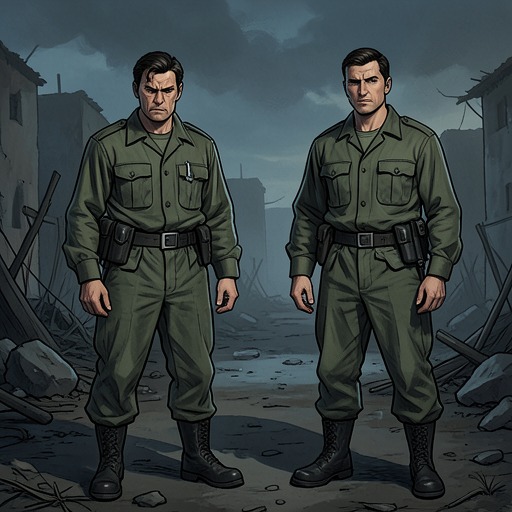
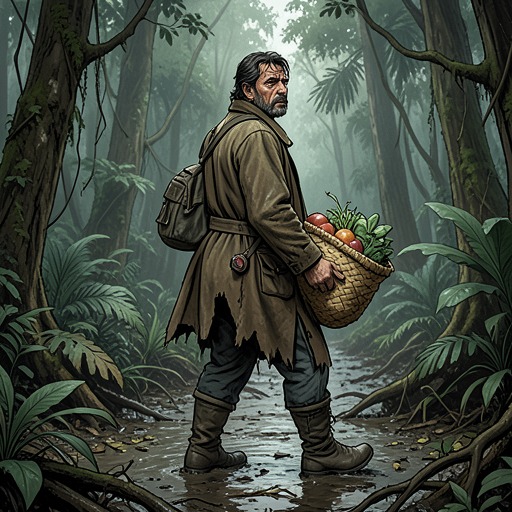
Tiny Middleton's collapse and death
The Narrow Road to the Deep NorthTiny Middleton’s collapse and death show how forced labour on the Death Railway reduces even a powerful man to a life measured by work, illness, and survival. His breakdown begins during a night shift at a rock cutting; in the weeks that follow, his strength ebbs while Darky Gardiner remains responsible for him. The narrative sets Tiny’s death against a camp where prisoners are counted as potential workers even when none is truly fit, and where the dead accumulate without a reliable reckoning.
The railway and the labour regime
The men’s collapse takes place within the accelerated work regime known as the Speedo. As the prisoners fall behind Japanese schedules, they face longer hours, reduced food, beatings, and night shifts added after they have already worked through the day. The cutting where Tiny falters is six metres wide, seven metres deep, and half a kilometre long. Its work is carried out by firelight and crude torches; hammering into rock demands concentration even as exhaustion makes the task increasingly difficult. Tiny is already suffering from malaria when the night work begins.
The railway’s completion is treated as an imperative that overrides the survival of the men building it. Major Nakamura understands that many prisoners may die, but persists because the railway has been ordered. Colonel Kota makes the requirement explicit: the work must be completed even if most of the men die, or even if everyone dies. In this system, prisoners are treated as material for construction rather than as people whose illness should stop the work. Tiny’s collapse is therefore not an isolated failure of endurance but one consequence of a labour system that demands continued output from men whose strength is disappearing.
The larger historical frame gives that demand a scale beyond the camp. Of twenty-two thousand Australian POWs, nine thousand are sent to work on the railway. When the first train travels its length on 25 October 1943, it passes the remains of human beings, including those of one in three of the Australians who worked there. The account also stresses that the Australians were only a fraction of the labour force: estimates of deaths among the much larger group of Asian labourers vary widely, and no agreed total exists. These figures do not specify the circumstances of Tiny’s death, but they locate his experience within a project whose human cost could not be reliably counted.
The collapse at the cutting
During the first night shift, Tiny’s usual strength no longer carries him through the work. Malaria makes his body shake, and the sledgehammer’s familiar movement becomes an effort. Darky has to move out of its path more than once as Tiny loses control. After an uncertain period of work, Tiny lowers the hammer and drops to the ground.
The Goanna, a guard whose slow, deliberate movements often precede violence, approaches and beats Tiny with a length of bamboo, then kicks him. The immediate change Darky notices is not simply that Tiny has been struck: the man who once endured beatings with apparent defiance now lies helpless and begins to sob. His breakdown is startling to those around him because crying has become unusual on the Line, where pain and despair are already part of daily life. Tiny strikes at his own chest as if trying to resist what is happening to him. The narrative presents the moment as a rupture in his former confidence in his body: the strength that had carried him through hardship can no longer protect him.
Darky’s care and Tiny’s decline
Tiny does not recover after the collapse. Over the following weeks, Darky watches his body weaken and sees him become increasingly indifferent to beatings, washing, and the conditions around him. The change is gradual, but Darky understands that something fundamental has given way. Tiny himself seems to know that he has nothing left with which to resist what is coming.
Darky’s response is marked by conflicting feelings. He stays with Tiny, but resents the deterioration of the once-proud man and fears that Tiny has simply given up. He recognizes that this judgment serves as a defence: imagining that Tiny could choose to live makes it easier to believe that survival remains within his own control. Darky knows that it does not. He helps Tiny anyway, not because his resentment has disappeared, but because Tiny is his mate. Their connection makes care a responsibility that persists even when it is difficult, and the men’s shared dependence gives that responsibility a larger meaning: abandoning one person would mean abandoning the group’s claim to survive together.
Death amid the camp’s arithmetic
Tiny’s death is confirmed in a scene of counting and selection. As prisoners gather in the rain, Dorrigo Evans reports the camp’s numbers to Major Nakamura: four men died the previous day and two overnight, leaving 838 POWs. Of those, 67 have cholera, 179 are seriously ill in hospital, and 167 can manage only light duties; a further 62 report sick that morning. Dorrigo presents 363 as the number available for railway work, but he knows that this figure does not describe men genuinely fit for the Japanese demands. He is trying to calculate which prisoners are least likely to die if made to work, a task that recurs each day under pressure from the guards.
After Dorrigo lays a sick man down beside the others, he turns back and sees rain passing over Tiny’s corpse. The understated recognition places Tiny among the camp’s dead without offering a precise account of when or how he died. His absence registers at once as an individual loss and as another addition to a tally that can never fully express what has happened to the prisoners. The rain covers the railway materials and the dead alike, while Dorrigo’s daily calculations continue around them.
Significance
Tiny’s story connects bodily collapse with the coercive logic of the railway: the work continues regardless of whether the prisoners can safely perform it, and a man’s decline does not release him from the system’s demands. His death also sharpens the contrast between arithmetic and comradeship. The camp can report totals of workers, sick men, and deaths, but Darky’s care for Tiny insists on a bond that those categories cannot capture. In the wider account of the railway, where the number of Asian labourers who died remains disputed and many names have been forgotten, Tiny’s death is one particular life within a much larger, incompletely recorded catastrophe.